

Théories féministes en droit international
11 novembre 2021 • 11H30 13H
Webinaire (Zoom)
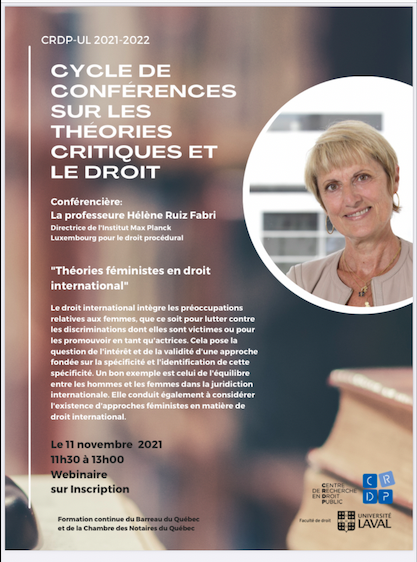
Dans le cadre de son Cycle de conférences 2021-2022 sur le thème Les théories critiques et le droit, le Centre de Recherche en Droit Public – antennes Université Laval a le plaisir d’accueillir la professeure Hélène Ruiz Fabri, directrice de l’Institut Max Planck Luxembourg pour le droit procédural, où elle dirige le département de droit international et de règlement des différends.
Résumé
Théories féministes en droit international
Le droit international intègre les préoccupations relatives aux femmes, que ce soit pour lutter contre les discriminations dont elles sont victimes ou pour les promouvoir en tant qu’actrices. Cela pose la question de l’intérêt et de la validité d’une approche fondée sur la spécificité et l’identification de cette spécificité. Un bon exemple est celui de l’équilibre entre les hommes et les femmes dans la juridiction internationale. Elle conduit également à considérer l’existence d’approches féministes en matière de droit international. En effet, l’ouvrage novateur de Hillary Charlesworth, Christine Chinkin et Shelley Wright intitulé « Feminist Approaches to International Law » (publié dans l’American Journal of International Law en 1991) reconnaissait déjà la diversité des approches féministes, toutes critiques, mais plus ou moins radicales. Il pose la question de l’intérêt et de la validité des approches genrées.
Conférencière

Hélène Ruiz Fabri est directrice de l’Institut Max Planck Luxembourg pour le droit procédural, où elle dirige le département de droit international et de règlement des différends. Avant de rejoindre l’Institut Max Planck Luxembourg, Hélène Ruiz Fabri était professeure à l’École de droit de la Sorbonne (Université Paris 1 Panthéon-Sorbonne), dont elle a été directrice pendant quatre ans. Elle est titulaire d’un doctorat en droit international et de deux diplômes de troisième cycle (Master 2) en droit public et en sciences politiques. Elle est actuellement membre du Conseil d’éthique du ministère français de la recherche et de l’enseignement supérieur et a beaucoup travaillé sur les questions de déontologie. Elle a également une expérience de la pratique juridique, notamment en conseillant diverses organisations sur les droits de l’homme ou la diversité culturelle et en agissant en tant que juge ou arbitre.
Le professeur Ruiz Fabri a beaucoup travaillé sur les femmes en droit international / les femmes et le droit international, notamment sur la mise en œuvre de la Convention sur l’élimination de toutes les formes de discrimination à l’égard des femmes (CEDAW) et sur les perspectives ou approches féministes du droit économique international et de l’arbitrage international. Elle est actuellement co-éditrice du Oxford Handbook on Women and International Law, avec Nienke Grossman, Jaya Ramji-Nogales et Josephine Jarpa Dawuni.
Une attestation de participation, représentant 1 heure et 30 minutes de formation continue, sera transmise par courriel aux avocat.e.s et aux notaires ayant complété le formulaire de présence. Un délai de 10 jours est requis pour la réception de l’attestation. Pour participer à cette conférence, il faudra s’inscrire en cliquant ci-dessous.
Ce contenu a été mis à jour le 12 janvier 2022 à 22 h 14 min.